Sampling Strategies for High-Volume Agent Trace Pipelines
Hybrid sampling preserves agent failures and costs while controlling pipeline overhead.

Traditional error monitoring fails for AI agents because an execution that succeeds does not prove the agent did the right thing. An agent can return a 200 response while ignoring instructions or producing a wrong answer. A hybrid sampling model must control routine trace volume while preserving detected failures, anomalies, and high-cost executions, and silent misbehavior still requires instruction-aware auditing.
Why agent traces are structurally heavier than microservice traces
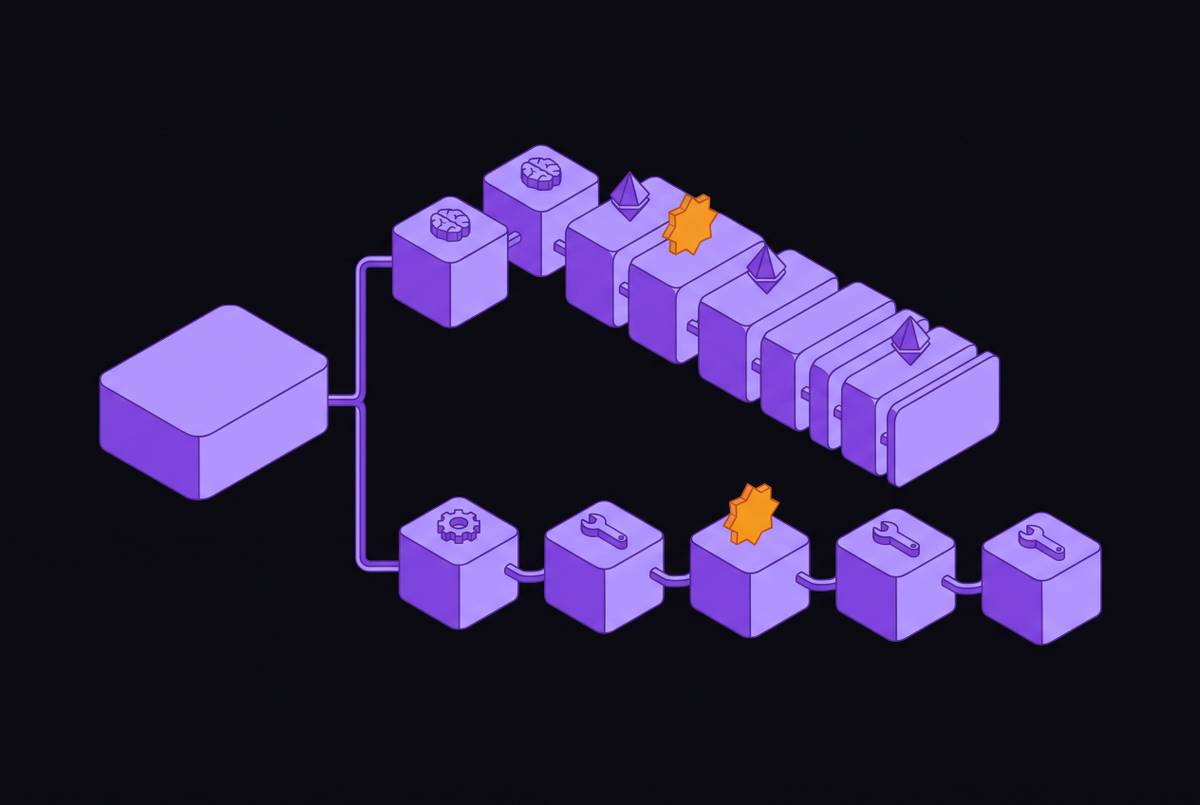
A traditional microservice trace follows a comparatively predictable path through database queries, cache access, and a response. Latency and errors live in known parts of that path. An agent request can instead trigger retrieval, reranking, embedding generation, model calls, and tool invocations before producing an answer. Guardrail checks, self-reflection steps, and sub-agent handoffs extend the execution further.
Retries make that structure more demanding. When a model call fails, the agent may retry, call a fallback model, or take an alternate tool path. Each of these paths adds work to the same logical request. These non-linear reasoning loops make a long trace more than a slower version of a short one. A trace may be long because the agent recovered, kept making mistakes, or strayed from the task.
Cost accumulates throughout the execution as token usage and API call volume are distributed across child spans, so no single model call necessarily reveals the expense of the whole request. An apparently ordinary step may belong to an execution whose total cost is anomalous. Understanding that execution therefore depends on the relationships between spans and the totals across them. This combination of branching, delayed outcomes, and distributed cost breaks conventional assumptions about which traces are worth retaining.
What head-based sampling actually drops in an agent context
Head-based sampling decides whether to keep a trace at its start. That decision precedes tool outcomes, accumulated cost, and evidence of a runaway loop. Random selection at this point cannot distinguish a routine response from an execution that will later become expensive or wrong. With many traces and a modest retention rate, valuable evidence of failures is often lost. The sampler is not judging that evidence as unimportant because the evidence does not yet exist.
Consider a malformed tool call that receives a 400 response. The agent may loop or silently fabricate a result without the overall execution crashing. A prompt that truncates critical instructions may still produce a 200 response with degraded output. A retry loop may burn tokens across forty iterations before giving up. None of these outcomes is available to a sampling decision made at the root span.
These failures include tool-call failures with invalid arguments, context truncation, runaway loops, and silent quality regressions. Production monitoring platforms such as Lemma address these agent misbehaviors, but any downstream analysis is constrained by the traces that survive collection. Some failures leave structural evidence after execution, while others require examination of the content against the instructions. Head sampling cannot use either kind of evidence at trace start.
Its advantage is real because an early decision is computationally cheap and limits pipeline load. Its cost comes later, when incidents take longer to detect and evidence of harm to users is lost. Routine happy-path executions lend themselves to sampling. Rare failures do not, which creates the central asymmetry of head sampling for agents.
What tail-based sampling preserves and where it breaks down at scale
Tail-based sampling defers the retention decision until the completed trace exposes its outcomes. The decision can then use error status, latency, token cost, tool results, and step count. A trace that eventually succeeds after excessive retries can be retained because of the retries. This is the right conceptual direction for agents because value becomes visible during execution.
With complete traces and explicit signals, tail rules can retain every matching failure, expensive execution, or anomaly in full. Tool execution errors, hallucination detection signals, and overruns of the planned step count can all cause a trace to be kept. Routine successful executions can then be sampled aggressively. That guarantee has a boundary, however, because the trace must reach the sampler and the relevant condition must be observable. A rule cannot recognize an unrecorded failure.
The operational limit comes from waiting for that evidence. The OpenTelemetry Collector must buffer in-flight traces until they complete before applying completion-based tail rules. Agent traces that last minutes or hours stay in that buffer as new requests arrive. When many requests arrive and take a long time to finish, they put more pressure on the collector. Deciding late remains sound in principle, while buffering unfinished work strains the collector.
Heavy telemetry also increases the work of receiving, processing, batching, and exporting data. Those earlier costs still apply even when less data is stored at the end. Pure tail sampling can consequently destabilize the collector before its selective retention delivers a benefit. Head sampling is cheap but blind to outcomes, while tail sampling sees outcomes at the cost of buffering them. A hybrid architecture separates these two responsibilities.
The hybrid sampling architecture that handles both constraints
The first layer controls how much trace traffic enters the buffered pipeline. Parent-based TraceIdRatioBased head sampling cuts the number of traces the collector must hold. OpenTelemetry defines OTEL_TRACES_SAMPLER as the SDK sampler setting and provides parentbased_traceidratio for proportional root sampling with parent-child consistency. That consistency matters when a logical agent execution crosses service boundaries.
The second layer uses outcome-based retention rules to decide which of the completed traces that reached it to keep. Tool errors, schema validation failures, step count overruns, high token cost, latency outliers, and safety signals become always-keep conditions. Successful traces within expected cost and latency, with no tool errors or other flagged behavior, receive aggressive sampling. This concentrates retained evidence on executions with a concrete reason for examination. Agent deviation signals, including those relevant to instruction-aware monitoring such as Lemma, belong in this priority scheme when they are available before the retention decision.
There is an important limit to the pattern. A tail rule can override routine retention at the tail layer, but it cannot recover a trace already dropped at the head. The hybrid model therefore guarantees retention of matching traces that reach the tail sampler. A claim of universal preservation would be incompatible with blind upstream dropping. The distinction matters most when rare failures are the reason for collecting traces.
The third layer provides remote rate control during incidents, launches, and canary rollouts. Rates can rise for specific agent IDs, tenant segments, or prompt versions without having to redeploy the collector configuration. A structured trace hierarchy makes those targets meaningful across services.
Which trace attributes should drive tail-sampling rules for agents
Tail rules need attributes that describe the agent’s decisions and their consequences. Tool outcomes are the clearest starting point. API 4xx/5xx responses, schema rejection, and receiving-side argument validation failures are all reasons to keep a trace. Argument failures deserve particular attention because they may produce no error span of their own. Retry counts above expected bounds identify runaway loop candidates even when the execution eventually succeeds.
Resource rules should check the whole trace. Total token count above the P90 baseline for that agent can identify verbose, looping, or off-task behavior. Another signal is an inference-call count that exceeds the planned step count for the task. These checks show which reasoning paths cost much more than the agent’s usual work. Latency outliers add an operational reason to retain the execution.
For behavioral rules to work, the sampler must be able to see evidence of quality. A guardrail that flags hallucination should trigger retention. If downstream parsing finds an output schema failure, that result must propagate back as a span attribute. Policy-adjacent actions, including a refund decision, an account write, or a privileged action, warrant always-keep treatment because missing one can cost more than retaining many.
Coverage also matters beyond known failures. Inputs outside the distribution of recent retained traces are worth keeping even when execution succeeds, because they expose gaps between test coverage and production diversity. Embedding- or cluster-based novelty detection at the collector layer requires more infrastructure, but supplies that distinct signal. More traces from premium or enterprise tenants should be kept as a baseline because of SLA accountability and the complexity of their workloads. Root-level tenant attribution propagated through child spans makes that priority usable without confusing it with an error condition.
Why agents look fine in logs but still give bad outputs to users
The hardest failure is an execution that satisfies every structural health check while violating the task. It returns a 200 response, records no tool error or schema violation, and stays within normal latency and token usage. Yet its output is subtly wrong. An agent may fabricate an identifier instead of retrieving it, promise a refund outside the policy window, or route a payment to the wrong pool. Successful delivery does not establish that the content or action was correct.
These cases expose the boundary of traditional error monitoring. An accepted API operation establishes only that the operation ran, leaving the agent’s entitlement or instruction to perform it unverified. A clean trace can therefore record a failed task. If no behavioral signal distinguishes that trace, a rule-based tail sampler will classify it as routine and sample it aggressively. The absence of an error attribute is not evidence of instruction-following.
Retaining the trace is necessary for later examination, but retention alone does not explain the failure. The monitoring layer must compare what the agent did with what it was supposed to do. A language model evaluator can examine retained traces for semantic errors, but evaluation after sampling cannot rescue evidence that sampling discarded. Treating that evaluation as a retention trigger creates a circular dependency unless its signal exists before the decision.
Lemma audits every trace against the agent’s instructions and groups recurring deviations into issues, addressing a different question from ordinary sampling. That approach examines intent rather than waiting only for predefined error conditions. It can only use the traces that reach it after upstream sampling. The complete design separates which executions sampling keeps from whether instruction-aware auditing finds that a seemingly healthy execution did the right thing.
Designing sampling rules that keep pace with a changing agent
Sampling rules drift because the behavior they describe changes. Prompt edits alter expected outputs, and tool schema changes alter the failures a rule must recognize. A field renamed from account_id to accountId can leave a rule watching the wrong attribute. Model updates shift token cost distributions and step count baselines, so P90 thresholds need recalibration. New tool integrations introduce failure patterns that existing conditions may not cover at all.
Scheduled golden-trace replay provides a practical check on that decay. A fixed set of representative traces, including known failures, is replayed against the current production configuration on a regular cadence. If a golden failure trace no longer receives retention, the rule set has lost coverage and needs updating. This is the observability equivalent of a regression suite. It tests whether the monitoring configuration still recognizes the evidence it was designed to preserve.
Key retention metrics should also be used as CI gates alongside application quality metrics. Schema validity retention rate and error trace retention rate test the visibility of failures. A deployment that lowers error trace retention is a reliability regression even when application tests pass. Remote rate control provides a temporary response when a new prompt version or tool change ships. Keeping more traces for the affected agent gives teams time to understand its changed failure profile before settling on rules.
The objective is a maintained relationship between the agent’s current behavior, the signals recorded in its traces, and the rules that retain those traces. Golden-trace replay tests known coverage, while instruction-aware auditing addresses deviations that predefined rules do not explain. Neither removes the need to understand what upstream sampling has excluded. Agent drift and sampling rule drift pose the same danger because both go unseen without active instrumentation.